



To entice all you sustainability minded folks—particularly in Oregon, BC, Idaho, and Eastern Washington—to sign up for our Sightline Daily news service, we’ve been offering a free trip to Seattle. What’s so great about Seattle? Well, lots—and if you’re like me, and think of trips as opportunities to learn something new, there’s plenty to learn about sustainability in the Emerald City.
So here are 5 sustainable wonders in Seattle—things that any city would do well to emulate…
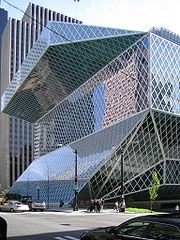
 1.Awesome Libraries. By the numbers, Seattle is a city of avid readers: it’s currently tied with Minneapolis as the nation’s most literate city, and it’s at or near the top of US cities in both the number of bookstores and library withdrawals per capita. So it’s little surprise that the city voters consistently support the city’s libraries. In some cases, they’ve even splurged a bit—with some very fine results.
Case in point: the Central Library, smack in the heart of downtown. It’s fascinating architecture; in fact, The New Yorker called it “the most important new library to be built in a generation.” From the street level, it’s an imposing building —so much so that it probablyviolates Seattle-based blogger David Sucher’s three rules for pedestrian-friendly urban design. But despite my initial misgivings about the building’s scale, I’ve found that the Central Library actually enlivens my experience walking downtown. It’s been part of the cityscape for half a decade, yet the building’s striking design still catches my eye every time I see it. And I’ve found it both inspiring and functional on the inside. Sightline’s book Seven Wonders for a Cool Planet pegged libraries as a wonder of the sustainable world—and with its many green features and transit-friendly location, this one fits the bill more than most.
2.Climate Leadership. Although two-term Seattle mayor Greg Nickels didn’t make it through this fall’s primary, he can certainly be proud of one of his lasting legacies: his national leadership on climate policy. During a time when climate denialism was the norm in national politics, Mayor Nickels spearheaded the Mayors Climate Protection Agreement— one of the few signs of intelligent life in national climate policy at the time. The agreement aimed to commit US signatory cities to meeting the Kyoto accord’s emissions reduction targets. By late 2007, the agreement had garnered the support of mayors from 710 cities nationwide—encompassing more than a sixth of the US population, and offering hope to Europe and other developed nations that the US would someday adopt some saner thinking about climate protection.

 3.Showing That Buses Can Work. Until just a few months ago, Seattle essentially had a bus-only transit system. (The Sounder rail service served long-distance suburban commutes rather than in-city trips, and the two trolleylines, one of which is now defunct, barely registered as blips in overall transit statistics.) And yet despite the widespread perception that rail transit is the sine qua non of sustainable transportation, the Seattle metro area performed surprisingly well on transit statistics, even without a train. For example, more commuters take transit to work in Seattle than in Portland, even though Portland has invested heavily in its MAX light rail system. Higher rates of transit commuting are one reason that Forbes Magazine ranked Seattle ahead of Portland on clean commuting.
I’m not arguing against light rail here—just pointing out that Seattle’s transit system has produced some fairly impressive results for a mid-sized American city—and achieved that record even without light rail.
4.The Electric Company. Yeah, most utilities are dull. Even Monopoly ® strategists tell people to avoid them. But Seattle City Light is surprisingly hip: the city-run electric utility was the first climate neutral electric utility in the US and has won accolades for its work to conserve salmon habitat.
Seattle’s in a pretty unique position: the city owns and operates two hydropower projects that provide the bulk of the city’s power, and also has ready access to hydropower from the grid—making it pretty easy to claim the “climate neutral” mantle. Still, SCL’s done more than most US utilities to minimize its contribution to global warming: for the fossil power it does buy, SCL takes steps to offset the climate impact by encouraging energy efficiency, plugging idling cruise ships into the grid, and even partnering with local transit agencies to reduce their carbon footprints. So if you’re in Seattle, every flick of the light switch reminds you of the city’s commitment t
o climate stewardship.
5. Biking on Water. Seattle many many delightful opportunities to ride a bike near a beautiful body of water—whether it’s Puget Sound, Elliot Bay, Lake Washington, or Lake Sammamish. The excellent Burke-Gilman Trail gives great (though intermittent) views of Lake Washington, Portage Bay, Lake Union, the Ship Canal, and Puget Sound. And if you’re up for a longer ride, the Burke eventually links up with the Sammamish River Trail and, later, the East Lake Sammamish Trail.
And if you visit between May and September, Lake Washington Boulevard is closed to cars on Sundays. “Bicycle Sunday” attracts hundreds of cyclists of all levels, from hobbyists to the hard core. And on a decent day, putting your bike on the ferry to Vashon, Bainbridge, Southworth, or Bremerton is a cheap way to get great views of the city of Seattle, nestled in the midst of the spectacular natural scenery that even Seattle natives don’t take for granted.
So that’s my list of things that sustainability-geeks can learn from Seattle. What’d I miss? Comments welcome.
Image of Seattle Central Library courtesy of DVD R W, distributed under a GNU Free Documentation and Creatve Commons license.
Bus photo courtesy of Flickr user VeloBusDriver, distributed under a Creative Commons license.


Alan Durning
The Mayor’s climate initiative has now got more than 1,000 signatories!
Mark Withers
Local food! Farmer’s markets in communities citywide and the Pike Place Market give Seattleites access to fresh, locally grown food year-round.
David Sucher
While the Central Library certainly does violate the Three Rules and in fact does not contribute to the walkability of downtown Seattle (except as eye candy) the tragedy is that it could have been both: brilliant eye candy and also adhering to the Three Rules so that it contributes to a lively sidewalk.There is no inherent conflict between starchitecture like Koolhaas’ Central Library and walkable urbanism. In practice of course very little startchitecture is designed to enhance the walkability of its neighborhood. But it doesn’t have to be so. We can have both and the tragedy is that there is an assumption that we can’t.
Eric Hess
Mark—You’re right! Food is another great thing about Seattle. We just posted on it here.
Clark Williams-Derry
David—I agree. If the architects had paid more attention to the bottom 20 feet of the building, it would have been a better project.
Oregon Michelle
What else is so great about Seattle?Having one of the world’s greatest bookstores within walking distance of the train station!But you’d better hurry because, unfortunately, it might be relocating out of Pioneer Square and way over to Capitol Hill…