


On Thursday, the state Department of Ecology will tip its hand on its plan for new stormwater regulations for Washington’s cities and counties in a meeting at its headquarters.
Folks concerned about saving Puget Sound say the stakes are high. Stormwater—and the millions of pounds of pollution that it carries, plus the damage it does when it blasts through salmon streams like a fire hose—is considered the prime threat to the health of Washington’s inland sea.
The regulations from Ecology will in turn dictate how cities and counties set rules for how houses, businesses, public buildings, roads, and parking lots will be built. While the slow economy recently has tapped the brakes on growth in the Northwest, our population is expected to keep swelling, which means more development and challenges to protecting our waterways.
The aspect of the new rules that’s getting the most attention deals with when and how to require the use of low-impact development, which is the practice of trying to help stormwater soak into the ground where it falls, rather than shunting it away through storm drains and gutters and into rivers, lakes, or the sea.
Ecology didn’t decide to tackle the low-impact development question just for kicks. After a coalition of green-leaning groups challenged the department’s existing stormwater regulations as being too weak, Ecology was ordered by the Pollution Control Hearing Board to spiff ’em up.
Excerpts from the state’s marching orders (pages 57-58):
“…we conclude that under state law, the permit must require greater application of LID techniques, where feasible…”
“…the testimony presented by PSA (Puget Soundkeeper Alliance and People for Puget Sound), the Utilities and Ecology’s technical experts leads to the indisputable conclusion that application of LID techniques, at the parcel and subdivision level, is a currently known and existing methodology that is reasonable both technologically and economically to control (stormwater) discharges…”
After the ruling dropped, Ecology formed two advisory committees to tackle the matter of defining low-impact development, and determining when it should be required.
The meeting Thursday will be Ecology’s public unveiling to the committees of the new rules (though you can get a sneak peak of what’s going to be presented in the meeting materials).
Details of the meeting:
When: Aug. 12, 10 a.m. to 4 p.m.
Where: 300 Desmond Dr. S.E., Lacey, in the Ecology Headquarters Auditorium
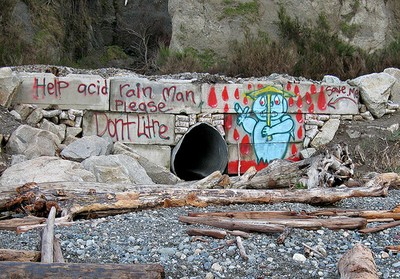
Acid rain man photo shot at Richmond Beach, located north of Seattle, by Flickr user pfly under a Creative Commons license.




old galoot
Lisa,Would you check the date? Looks like it might be next Thursday (Aug 19):Aug 19 1 PM – 4 PM Public Meeting: Lacey Phase I and II Municipal Stormwater General Permit Listening Session The Department of Ecology is beginning a process to reissue three Municipal Stormwater General Permits that expire in February 2012. Listening sessions will provide a forum for interested parties and stakeholders to offer suggestions to Ecology for improvements to these permits. Phase I and Phase II Municipal Stormwater General Permits Listening Sessions Location: Lacey Timberland Library 500 College Street Lacey, WA Map Sponsor: Dept of Ecology / Water Quality Contact: Julie Lowe (360) 407-6470 / jlow461@ecy.wa.gov Associated Public Meeting: Aug 4Associated Public Meeting: Aug 10Associated Public Meeting: Aug 11Associated Public Meeting: Aug 13Associated Public Meeting: Aug 24Associated Public Meeting: Aug 27Associated Public Meeting: Sep 8
mark
Page I-25 of the Ecology stormwater manual (0510029) says that “Ecology understands that despite the application of appropriate practices and technologies identified in this manual, some degradation of urban and suburban receiving waters will continue, and some beneficial uses will continue to be impaired or lost due to new development. This is because land development, as practiced today, is incompatible with the achievement of sustainable ecosystems. (emphasis added).So why was this approved by EPA, as losing “beneficial uses” is contrary to the Clean Water Act and Washington’s own Water Quality Standards? Maybe they will get it right this time.
Lisa
Re: the meeting, Ecology definitely has this joint meeting on the calendar for Aug 12. There are also a number of “listening sessions” scheduled for around the Puget Sound region, including the Aug 19 session referenced by “Old Galoot”. Hope that helps clear that up (and you can check the agenda of the meeting by clicking on that first hyperlink in the post—the bold “a meeting”).And Mark, thanks for your comment. It is odd. Ecology seems to acknowledge again and again that the current stormwater manual won’t save the Sound and other waterways from damage, yet they’ve been resigned that that’s the best they can do. And who can explain why EPA would sign off on it as well?!I’ll be reporting back on what’s said at Thursday’s meeting, so stay tuned.
Dieter
And I always thought the US was a developed country. Just look @ (Western) Europe. I can only speak for Germany but don’t think the neighbouring countries are much different. All rain water run off is treated in their sewage treatment plants. And if there is a downpour they have rain water retention pools, millions of cubic meters, all over from which they release water when capacity @ the treatment plant allows. More recently authorities went one step further. A home owner is charged sewer rate per square meter of sealed surface which does not allow rain water to seep into the ground water table, i.e. roofs, drive ways, garages, etc. and average annual rain fall. You can avoid this sewer rate by installing a rain water collection and usage system.Would this be food for thought?Dieter