



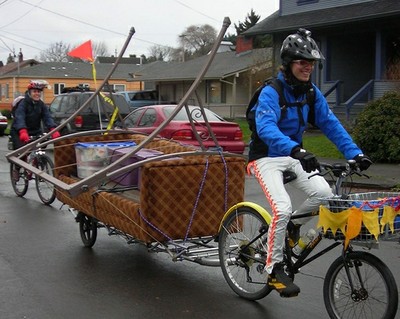
 Not at all. Thanks to impressive new bicycle trailer designs, such a move is now possible. So are other, similarly audacious feats of human-powered hauling, from freighting fish to delivering mattresses. (More on that in a moment.)
In 1981, when I left for college, (almost) everything I owned fit in a backpack, a trombone case, and an airline bike box. By 1993, all of my worldly possessions and those of my small family fit in a 15-foot Ryder truck towing a Honda Civic. By 1996, my family’s possessions had increased to a 24-foot truck and a Volvo station wagon. By 2000, I had a family of five and the largest dwelling I ever expect to own, and my 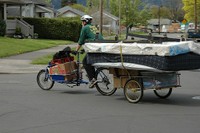
 possessions had proliferated further still. But in 2006, I reached the high point. I shed the car. The following year, my eldest son headed to college, taking a pickup-load of stuff with him. Then my family, uh, changed, and a bunch of the possessions in the house moved out.
Since, I’ve been trying to shed possessions more quickly than I accumulate them. My guiding principal is reduction: nothing comes into the house unless things of greater mass go out. The motive for this purging is part ecological (discussed in my 1992 book How Much Is Enough? The Consumer Society and the Future of the Earth) and part personal (a Thoreau-like taste for “simplicity, simplicity, simplicity”). But since I first learned about bike moves in 2007, the thought of trimming my worldly possessions to a mass that can be transported by human power has become a fascination for me: a concrete benchmark against 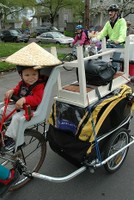
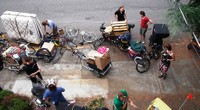
 which to measure my de-stuffing progress. Specifically, when I sell my house, probably in 2012 when my two younger children (knock wood) start college, I intend to move without a van. No oil. No pollution. No moving company or equipment rental. No diesel exhaust. I’ll still have more than I did when I went to college in 1981, but I expect to have less than a 15-foot-Ryder load. To move it, I won’t need anything but a flotilla of friends with cargo bikes and trailers, a rain-less day, and bungee cords. It will look like the scenes in the photos interspersed in this post, which are from bike moves in Portland, where muscle-powered changes of residence are commonplace. (In fact, Portland has an online organizing hub for bike moves.)
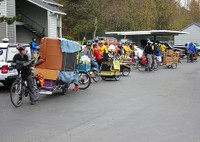
 (Two other noteworthy sets of bike move photos are here and here. And here’s a well-produced video from Boulder, Colorado.)
The possibility of bike moves depends, first and foremost, on having only a modest pile of stuff—hence my purging. It also depends on the emergence of remarkable load-bearing options. Fortunately, bike trailers, like the walking carts, convertible cart-trailers, and cargo bikes that I’ve written about in recent weeks, have enjoyed technical advances in recent years. Consequently, would-be bike teamsters are now confronted 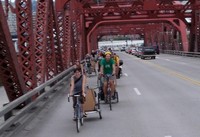
 with an embarrassment of choices, such as those catalogued by the Bike Trailer Blog. (Gear-head aside: I particularly like the Bikes at Work models, which can carry loads as heavy as 300 pounds and as long as a canoe. Sightline friend Patrick Barber has described his experience with these trailers. Like Oregon-made Burleys, which I described, BOB trailers are popular and reliable, and Oregon’s Blue Sky Cycle Carts are also intriguing.)
Not Just Bike Moves
Bike trailers are cropping up in other uses too. They’ve taken the place of pickup trucks for maintenance crews in Eugene’s Alton Baker Park. The Mattress Lot in Portland offers bike delivery of bedding on its custom trailer, as this video shows. Pedal People of Northampton, Massachusetts, has built itself a business in human-powered hauling. Community tree planters in Portland use trailers, along with cargo bikes, as pictured below.
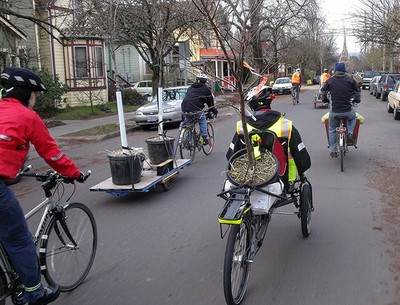
Perhaps most impressive of all, Fisherman Rick Oltman, who owns the F/V Cape Cleare of Port Townsend, Washington, estimates that he and his partner have transported 85,000 pounds of Alaska-caught salmon and oth
er fish to restaurants and farmers’ markets in the past year. And he’s delivered it all on two bike trailers. (Go here to see beautiful photos of Rick and his partner hauling about 300 pounds of seafood toward the Ballard Farmers’ Market in Seattle.)
What Does All This Mean?
Bike moves and bike hauling do not imply that bike trailers are a viable alternative to internal combustion for most uses and most people. They are not. In the grand scheme of urban transportation, oil demand, and carbon emissions, bike trailers and other human-powered freight haulers may remain side shows.
Still, they do save oil, and they seem especially appealing right now as our oil addiction poisons the Gulf of Mexico. Perhaps their appeal is more symbolic than practical. They are embodiments of the joyful, festive, and quixotic culture that we urgently need if we are to transform our energy economy. Bike moves, like other human-powered freight hauling, exemplify a way of life in which community is strong, possessions few, and life rich. And examples are ever more important. Or so it seems to me.
What do you think, readers? Does something speak to you about bike moves? Will your next relocation be on two wheels? More selfishly, will you help me with mine?
Huge thanks to volunteer and urban planner Alyse Nelson for doing research that made this post possible.
Photo credits:
- Couch move by bike: Flickr photographer Brad Reber, Creative Commons.
- Bike move gathering: Flickr photographer theoelliot, Creative Commons.
- Hauling a mattress and frame: BikePortland.org on Flickr, Creative Commons.
- Bike move with kiddo along for the ride: BikePortland.org on Flickr, Creattive Commons.
- Bike move procession: Flickr photographer Brad Reber, Creative Commons.
- Bike move across Broadway Bridge, Portland, OR: Flickr photographer theoelliot, Creative Commons.
- Cargo train with trees: Flickr photographer gregraisman, Creative Commons.





Matt the Engineer
And as long as you keep moving downhill, it’s easy!(yesterday I pushed my broken-down car the one block, downhill, to the nearest auto repair shop. I never imagined a benefit to living in a walkable neighborhood would include being easy pushing distance to car services…)
MicheLynne
I hear ya about simplicity! But, since I’m presently located out in the country (and hoping to relocate into the city), my next move will definitely be by pickup truck!
Alan Durning
MtE,Portland is flatter than most of NW cities, in big sections, which helps bike moves there. But seeing as I live in lowland Ballard, in Seattle, I can’t guarantee my next move will be downhill.
Michael Andersen
My first bike move was two months ago; I’ve since helped on three more, and I’m fascinated by the whole thing.Here’s how onlookers react when they see a bike move parade, in extremely quick succession:1) surprise2) awe3) approval4) delightThis applies to nearby pedestrians, diners, truck drivers, etc. It’s a fantastic feeling and a beautiful bit of marketing for bikey living.In Portland, where these happen once each week or two, it’s also become a hugely practical institution in the support of low-car life. If you don’t own a car, moving is a BIG PROBLEM. And people in the bikey demographic move a lot. This replaces what would be a problem with a solution that’s superior (easier, cheaper and lots more fun) to a U-Haul move.Finally, it’s a precious example of something bikers usually lack: collective action. It’s a team-building, social-capital generating exercise. For the organizer, it’s a trust-fall: not knowing how many trailers are going to show up is nerve-racking … and the relief and gratitude when they do show up is blissful.If only everything we could to for our planet and community involved bliss.
Michael Andersen
By the way: Aaron Tarfman, the Portland bike hero in the left of that chili photo, has a plan to create a Zipcar-esque service for bike trailers, built around an annual membership fee. What a great idea.
Alan Durning
MA,Cool input—and photo. Thanks! Interesting point about collective action and social capital.Alan
AlanS
Hi Alan, You make the comment that bike trailers may not be practical or are probably not a main event in the scheme of things. (I paraphrase)I would like to point out their affect in use and as a visual focus may be larger than other prime movers for personal change / improvement than anything else to a regular person, and from that to our future together. Using you as a regular person, if I might be so bold, it has changed your perception of what you want to own and how you want to live based on a measure that may be as good as any tape you have ever used. That you want your possessions to be movable in a bicycle trailer with you and your friends pulling them. That sounds trans-formative to me. And immensely practical! As designer of the original Burley for my daughters, I can vouch for how formative it has been on my thinking and actions over the years. Because of my connection to the most popular (and most copied I am proud to say) children’s bike trailer for 30 years, I have seen many kids grow up in their Burleys. Not just a few, of that active wide generation pulling those trailers and riding those single speed self expressions, releasing their car back to the wild, find the same motivation as you. I think it is the emancipating effect of being able to move yourself and your stuff under your own power. And to afford to be debt free. Fairly universal with the young until the false return of the automobile fuzzes it out for them. Very practical. I am so glad my daughters learned that lesson. They will never be homeless or needy as they can live within their means, giving them time to think about helping others. Living without cars but bikes and bike trailers make them far more independent financially than all their peers taking the standard route. About 100-200 bike trailers can be built from one average autos material. Take the worlds resources and divide them out. You are still US expectation focused and yet you find a life that is bicycle shaped as an attractive and fulfilling not just alternative, but an improvement. The math gives the same results, a bicycle sized/shaped world for many, gives all what they need and opportunities beyond now. It seems the trailers are something more than just haulers. You Haul indeed. You are looking at the right order of magnitude for a happy fulfilled and not to mention healthier life. Thank you for pointing out to others this new culture forming from very smart leading edge action thinkers. At bicycle magnitude we can all be effective actors, not just ideas waiting for Congress to fund. Best in Cycling, Alan S
Reuben Deumling
Alan S,
I’d love to chat about bike trailers some time. If you’re open to that you could send me an e-mail at 9watts@gmail.com
I’ve been collecting, modifying, and building bike trailers from scrounged materials for a while now and am planning to rent them to a local audience here in Portland. But I’m fascinated by the early history of bike trailer designs. And there’s a renaissance of sorts underway, at least around these parts.
Reuben
Alan Durning
alans,Sightline is honored by your comment. You are a giant among us, the originator of the Burley! (And, as we’ve discussed elsewhere, other great things like the BikeFriday.)To your point, maybe you’re right that the trailer is more transformative than I’ve credited it with. I certainly find them captivating. Maybe what I was trying to say was that their greatest potential impact is as much cultural and technological?Alan
MicheLynne
And sociological!
Julien Myette
Hi Alan, thanks for that great post. I’ve translated it into French on my blog, let me know if it’s not ok with you. By the way, I’m operating a bike moving company in Montreal: Déménagement Myette 🙂
MicheLynne
And now international! Cool!From Julien’s blog:”…De manière plus égoïste, m’aiderez-vous avec le mien?”In other words, Alan, ya just might get some bike movers from Montreal! 😉
Alan Durning
Permission happily granted, Julien.I’ll brush up on my French before moving day, in expectation of some helpers from Quebec.
Julien Myette
Thanks Alan, how is going your French? 🙂 No problem if it’s not perfect yet, here’s the English version of the small guide where I share my experience with bike moves:
http://www.demenagementmyette.ca/bike-move-howto/
Hope it helps you and others with your next bike moves!
Reuben Deumling
“Bike moves and bike hauling do not imply that bike trailers are a viable alternative to internal combustion for most uses and most people. They are not. In the grand scheme of urban transportation, oil demand, and carbon emissions, bike trailers and other human-powered freight haulers may remain side shows.”Alan,I’m surprised you made this concession to present low saturation of bike cargo trailers. I own many of the bike trailers you list, but rely most heavily on my homemade 8′ flatbed trailer which happens to be mostly obscured at the front of the group of trailers in the tree-planting photo from Portland you posted above. I can and do haul things every day that my neighbors who own cars and SUVs can’t. I don’t see anything preventing bike trailers from picking up where fossil fueled cargo transport leaves off, expires, fades into memory. Is it the weight capacity? volume constraints? the low level of saturation among present bike folk? protection from the elements? the predominance of kiddie-trailers? that suggest to you this isn’t a viable alternative? If you lived in SE Portland as I do I think you might revisit that assumption. While the majority of my neighbors are probably still as car-dependent as in any other place in North America, the emergence of a vibrant biking subculture, including those devoted to living carfree and designing and using bike trailers to suit those circumstances, gives me great hope. a growing number of us move EVERYTHING by bike trailer: furniture, building materials, machine tools, soil, appliances, ladders, other bicycles, firewood, plywood, sheetrock, hardware, people, trees. Years ago I started a list of what seemed outrageous loads I’d hauled by bike trailer, but I soon quit because I found I could basically haul anything that needed hauling. I am planning on starting a bike cargo trailer rental business soon, and look forward to the intersection of declining oil extraction and the rediscovery of the bicycle’s cargo capabilities. When you’re in town you should stop by.Reuben Deumling
Reuben Deumling
Hauling cargo by bike, trike, and trailers continues to gain in popularity:
http://bikeportland.org/2011/09/15/national-attention-for-cargo-bikes-portland-in-bicycling-magazine-59049