



Editor’s note: This post is the first in a five-part series. Read more from the Parable of the Electric Bike.
Mmmm. An electric bike. Zipping through the city. Surging up hills without gasping for breath. Riding in business dress and arriving fresh and dry. Healthy, moderate exercise. No traffic jams. Free parking. Huge load-hauling potential. Near-free fueling. Zero emissions. Breeze in your face. Appealing!
So why haven’t e-bikes caught on (yet)? Especially in the Pacific Northwest, which is brimming with well-heeled tech enthusiasts? What’s stopping electric bikes from devouring automotive market share the way DVDs killed VHS? At least in good weather? Why aren’t they as commonplace on our boulevards as motorcycles or scooters or muscle-powered bikes or even motorized wheel chairs? Will they be soon?
Might electric bikes even be the vanguard of the electrification of all vehicles, rushing us through the long-awaited transition off oil and into a no-carbon future? Might this market-driven, job-creating electric vehicle revolution provide a detour around the bitter and intractable-seeming politics of climate laws? If we all push hard for electrification through the market, might we simply bypass the bickering morass of the US Senate, with its undemocratic procedures and filibuster rules?
I’m going to answer these questions. I swear. And, in the end, I’m going to conclude that the technical promise of electric bikes (and other electric vehicles) is not a short cut to a low-carbon, high-jobs future. Instead, it’s the other way around: good public policy is a short cut to electric vehicles. In other words, if you’re enthusiastic about e-bikes (and e-cars), you should work even harder for strong, fair climate policy; complete, compact communities; and best-in-the-world facilities for pedestrians and cyclists.
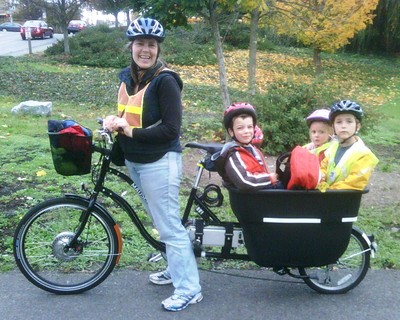
But that comes later. I need to start at the beginning, by which I mean the ultimate impetus for electric bicycles: the demand. Brynnen Ford, pictured above, illustrates. Brynnen uses her Madsen “as a minivan alternative.” She drives carpool with it, hauling kids to and from elementary school over the steep hills of Seattle’s central area. Before she electrified her cargo bike with an eZee motor and battery from cycle9.com, the hills were too much. “I tried doing it last year without the electric assist and while sometimes I could do it, other times I would opt for the car . . . so I wouldn’t die of exhaustion from carrying the kids up the hills. Now, I almost never opt for the car.”
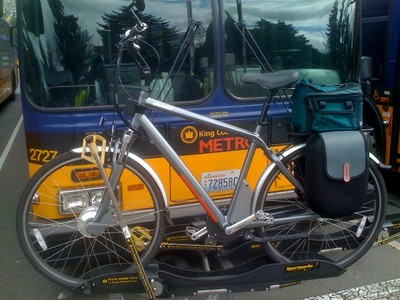
For Matt Leber, of Bellevue, Washington, a painful knee sparked his demand. An electric Giant Twist from Electric Bikes Northwest (pictured below) let his knee recuperate without injury. It also lets him commute 8 miles to his work as a bus driver without needing a shower. (And unlike Brynnen’s Madsen, it fits on the bus.)
For many others, as personal transportation author Katie Alvord says, “advancing age gives that electric option ongoing appeal—especially on windy days!” Many e-bike marketers, inventors, and enthusiasts are betting on baby boomers, with their active lifestyles, pro-fitness attitudes, and relative affluence, to push e-bikes into the mainstream in North America.
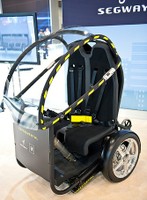
 Of course, where two-wheeled electric vehicles are concerned, we’ve been through cycles of high hopes before, as Ms. Alvord pointed out in E Magazine. Auto industry icon Lee Iacocca became an evangelist for electric bikes in 1999, but his company sold disappointingly few “E Bikes.” Just so, in 2002, Dean Kamen’s much-hyped two-wheeled electric Segway entered the market amid grandiose predictions of an imminent transportation revolution. John Doerr, arguably the dean of venture capitalists, predicted Segway would reach $1 billion in annual sales faster than any company ever. Instead, it took Segway until 2009 to sell its first 50,000, roughly what it hoped to sell in its first year alone. More recently, Segway has been working on a seated model with General Motors (pictured here).
Still, beyond the aging of the population, at least three reasons suggest electric bikes may soon break out of their novelty niche in the Pacific Northwest and the rest of North America. I’ll turn to them in part II of the Parable of the Electric Bike.
Read part two of this five-post series, “Charging Up.”
Photos of Brynnen Ford and Matt Leber’s Giant Twist courtesy of Brynnen and Matt. Segway PUMA photo courtesy of Flickr photographer saebaryo under the Creative Commons license.



Matt Leber
Full disclosure: At 62lbs, my Twist is over Metro’s weight limit of 55lbs per rack position. This picture was taken at the base on my way home when the Veloporter 3’s were brand new. I wanted to see if the new racks could handle my beast, which this one did without breaking a sweat. If I take out the batteries and carry them on the bus, it’s legal :)If you are considering an electric bike, there are many models today that are lighter and would be easier to use in combination with a bus commute. I encourage you to take a look. They can be expensive but they are far less expensive to operate than a car.I’m using my new Surly Cross-Check non-electric bike more these days since my knee is better. All that said, I still love my Twist and it gets lots of use – mainly for those days where I don’t want to break a sweat.
Kevin at Utah eBikes
GREAT article! Definitely one to share, and I look forward to reading your other installments.
JOJO
I’m a little embarrassed to say I never knew that electronic bikes were available. As a diabetic whose gone through two hip replacements, this might have been a great way to get back into the swing of things during my recovery.
Nicolas Davis
Actually, the world is long waiting for e-bikes to dominate the streets. Bikes use less energy and environment-friendly. I just hope they will come in cheap prices.