



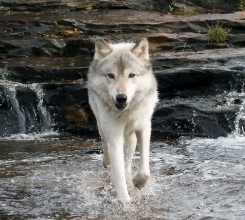
 Some good news for wolves in the west. As I reported in Tuesday’s Sightline Daily, there’s evidence that a second breeding pair of gray wolves has shown up in Washington State. Last summer, biologists confirmed the first wolf pack in Okanogan County—the first breeding pair to be found in the state since the 1930s. Another pair might now be residing in Pend Oreille County.
With loaded claims coming from both sides of the reintroduction debate, it was nice to see some good, science-based reporting from the Billings Gazette this morning (more coverage of the study here). A study by Montana State University takes a look at the wolf-elk relationship that’s developed in the Greater Yellowstone area, where wolves were successfully reintroduced in the mid-90s.
After reintroduction, elk populations dropped from around 18,000 to around 6,500. This year, the numbers are slightly over 7,000. Various explanations were given, from drought to over-hunting, but wolf predation on calves was seen as the most likely cause. However, the new study says scat evidence and radio-collar tracking shows relatively few elk calves have been killed by wolves.
The real culprit?
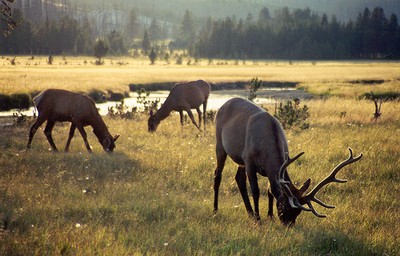
 In the absence of wolves, elk migrated down to large meadows where they could forage on grass throughout the winter. Reintroducing wolves forced the elk into the mountains, where scarce food (elk that could graze without the presence of wolves ate 27 percent more food) isn’t enough to keep pregnant elk healthy—and fewer calves were born as a result.
Certainly, wolf predation is a factor—but it can’t account for the entire drop in Yellowstone populations; reality is a bit more complicated. Changes in nutrition, brought on by the presence of wolves, were an unexpected but significant factor. The author of the study says it’s hard to tell if wolf/elk populations have reached an equilibrium, or entered a cyclical relationship—in which case current elk populations could rise for a time.
The moral of the story? Since wolves were eradicated from many of the western states nearly a century ago, local ecosystems have seen some dramatic changes—from inflated elk populations to changing riparian zones. As Northwesterners move forward bringing wildlife populations closer to historic levels, we’ll see some exciting—and possibly unexpected—transformations in Cascadia’s natural heritage.






CBear
The Brett French article in the Billings Gazette does a poor job of describing the research of Dr. Creel. He incorrectly states the conclusion of the study in the first sentence of his article.A clearer and more comprehensive analysis is in the Montana State University news release of the study. The title they use is “Greater Yellowstone elk suffer worse nutrition and lower birth rates due to wolves.”Furthermore, the issue is more complex tham Mr. Hess leads us to believe. Elk are not just being driven from riparian zones, they are being driven from ALL open, lower elevation, grazing sites by an ever-expanding wolf population.It is also interesting to note that elk were prairie as well as forest dwelling ungulates. Unfortunately, human settlement and livestock grazing on federal lands have taken up much of their winter range.As long as he is discussing reintroduction effects of wolves, he should also mention the fact that Wisconsin’s newly reintroduced elk population (a Wisconsin taxpayer funded effort with help from the Rocky Mountain Elk Foundation) has been trimmed extensively by the already reintroduced wolf population. The wolves have taken out a number of new elk calves and bearing cows. This is news was just reported earlier this week. The new Wisconsin wolf-elk diet has just set back elk reintroduction and management by a couple of years.
Eric Hess
Cbear—Thanks for your feedback. I’ve included the other article in the post. However, I didn’t say that elk were being driven from riparian zones. My mention of those zones was in reference to another post, linked to above, regarding changes in Olympic National Park.
CBear
Eric – You switched geographic areas from Western States to the Olympic Peninsula without reader signpost. Riparian zones have, in fact, been dramatically changed as a result of lack of wolves in many places. My contention is that in some areas, especially the West, and even Eastern Oregon and Eastern Washington, the damage is the result of overgrazing by livestock on federal lands. Get rid of the cows (and sheep), maybe add a very few wolves and the riparian zones will recover quickly. No need for elk populations to be cut in half by an ever-expanding population of very large non-native strain wolves.Whether wolves should be reintroduced to Olympic National Park is a good question, which has been under reveiw for several years in the Park’s planning process. Smaller wolves, if any and with a preference for salmon (yes it is true), from the Vancouver Island area seem to be closer in genetic lineage than these huge gray wolves working their way south from southern Canada to Montana, and the spreading of offspring from the 66 wolves Canadian wolves introduced to ID and WY in 1995. They are huge and larger, I am told, than what was once in the West.