


Density is good for many different reasons.
But people don’t make choices about where they live based on people per square acre any more than they base them on area median income. The choice of where to live, although influenced by test scores, cost of housing, proximity to work and amenities, is often influenced by qualitative not quantitative data.
Through the years I have seen my friends and co-workers following a typical pattern: graduate college, get a job, get married, look for a house, and then start having children.
Sometimes these things don’t happen in this order but for most educated middle class people in North America these things are frequently on the “to do” list one way or another. But changing the way we think about neighborhoods and plan for growth will open doors to new kinds of housing that is friendly to families and density.
Choosing where to live is usually something that doesn’t necessarily coincide very well with these life patterns. What suites us fine during one period of our life might not fit so well in another.
My colleague Clark Williams-Derry wrote about this problem in one of the Daily Score’s more popular posts. What is a person concerned with sustainability to do when the school issue arises? And this is especially true for people who have a deep sense of ambivalence about private education versus public education.
Clark agonized over this the way many people do. I want to live in a dense, lively city but what about the kids? Do I really want them playing kick ball in the streets of the Pearl District, Bell Town, or the West End?
How do we create familiy-oriented housing options that don’t require huge lots with big houses strung together by miles and miles of highways?
Portland’s cottage housing program built these issues right into updates to their land use code to support both density and families. It makes sense to meet family needs.
The basic idea of courtyard housing is simple. Build more, smaller units per acre and orient them around common space—space that’s away from traffic and focused on community. (Check out this post by Alyse Nelson on courtyards in Copenhagen).
The important question is how to make these kinds of developments more appealing and affordable than a typical detached single-family house. The city held a competition in order to get the most creative minds thinking this through.
The City of Portland also spent time compiling a very useful compendium on the Principles of Child Friendly Housing. The basics are that housing in compact communities should provide safe and accessible community space and streetscape that allows children the freedom for independent exploration with other kids in the neighborhood. This should be easy for parents to supervise without being overbearing. That’s what I remember being important growing up.
Another proposal cited in the review of Principles of Child Friendly housing is the woonerf. No it’s not a new fuzzy mascot for the program. It is yet another European solution to the challenge of safe streets. And Seattle is getting it’s first one (although people suggested that there are already a few woonerfs in Seattle). A development in the South Lake Union neighborhood will have a woonerf aimed at creating a streetscape scaled to people not cars. The Portland program cites this idea as yet another way of supporting family friendly housing choices.
The questions Portland’s design competition posed to entrants were the right ones to achieve family friendly designs:
- How can courtyard housing be designed to serve as an attractive option for families with children?
- How can courtyards serve as useable outdoor space while also providing environmental sustainability benefits, act as a setting for community interaction while also respecting privacy needs, or serve as a pedestrian-oriented space while also accommodating cars?
- How can courtyard housing avoid a purely inward focus and contribute to Portland’s tradition of street-oriented urbanism?
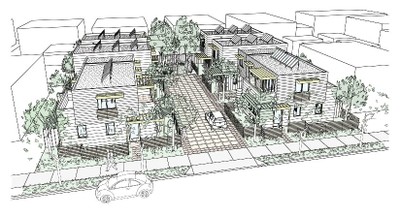
What made Portland’s competition so important is that the focus is on the end user not the designer or the code. As I wrote in a previous post [link] the code previously restricted what developers could profitably and legally do in single family neighborhoods. Here is the winning design:
And here is one of the runners up:
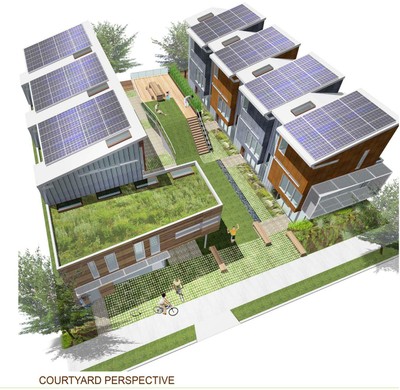
Portland’s competition got the best thinking about families and neighborhood design to inspire their codes changes for courtyard housing. This marks a departure from a car-centric and sprawl-friendly mindset that has shaped the last 5 or 6 decades of housing development. Turning a new leaf is good for families, neighborhoods, communities, our health, our pocketbooks—and kickball too.




joshuadf
It’s funny you mention both the Yale woonerf and kickball, since the LakeBall Kickball league plays at Cascade Playfield just three blocks from there. Alas, Blume’s Yale Campus is all office space though.I love courtyard apartments! There are three right together near the Burke-Gilman Trail at 25th Ave NE and Blakeley: the brand new private-access one for the Coydon Apts/Merill Gardens University, UW’s modern Nordheim Court, and the older Blakeley Village UW Family Housing which has playgrounds in the courtyards. Some friends lived there while in grad school and we loved visiting them.
holz
as the blume project is on hold, i don’t think we’ll be getting a woonerf for a while. (not that it really was, anyway since it’s not a residential project)
Matt the Engineer
I’ve always thought a common grass play area over a shared garage would work well even for suburban neighborhoods. It would increase density as well as a sense of community.