


The Center for Neighborhood Technology has made a new addition to its Housing + Transportation Affordability Index website that maps carbon dioxide emissions. The press release announces that “Urban Living Helps Curb Global Warming” and invites readers to compare where they live to other neighborhoods in their region.
So I did.
The map works just like Google Maps so it’s pretty easy. I live in census tract 0074 in Seattle which is one of the densest concentrations of people in the northwest, with more than 9,000 people on about 129 acres. That is about 69 people per square acre—well above the number that Sightline uses to gauge density in urban areas. Here is what the map shows for a census block in 0074 when I clicked on it:
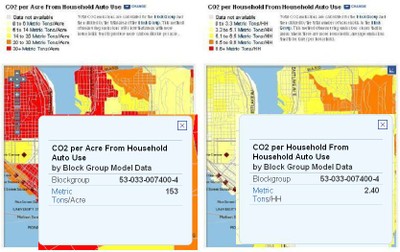
The number on the left—153—which is the number of tons of carbon emitted per acre struck me at first as high. But in order to understand the claims in the press release I needed to pick someplace in the suburbs to compare to my own urban ‘hood. So I picked a census tract on the Sammamish Plateau 32207.
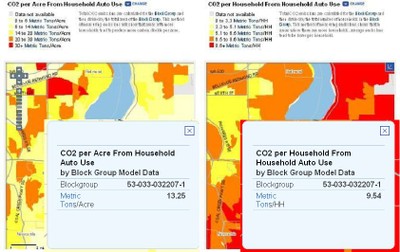
At first the tons of carbon emitted per acre threw me because it’s so low, only 13.25 tons compared to 153 tons for the Capitol Hill census tract. But as I wrote in another post, the real story is in the household number on the right; Capitol Hill is about 75 percent less per household (2.40 tons) than the Sammamish Plateau (9.54 tons). Similarly, the study I wrote about quantified emissions from denser developments in one part of Toronto and from less dense development in another part finding that emissions were higher per household in less densely populated areas.
Sure there are more people in denser neighborhoods. But why are they creating fewer emissions in their day to day activities? The higher concentration of people tends to make transportation choices alternative to the car—like public transit, biking and walking—more prevalent than in less densely populated areas. So the emissions attributable to individual households are dramatically smaller than in suburban areas where choices are severely limited.
The website tends to validate the idea that cities are actually more environmentally friendly than sprawling suburbs.





Comments