



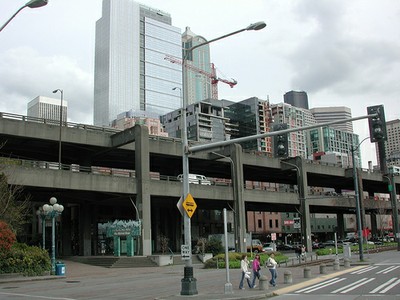
 Ah, the Viaduct—the gift that keeps on giving. Yesterday’s Seattle Timesquotes Washington’s House Transportation Chair Judy Clibborn (D-Mercer Island) as saying, “if you listen carefully you will hear a giant sigh.” She believes it’s a sigh of relief, because the state legislature is moving forward with a plan to replace Seattle’s aging Alaskan Way Viaduct with a tunnel.
But perhaps it’s a sigh of exasperation, exhaled by the 70 percent of Seattle voters who voted against replacing the Viaduct with a tunnel just 2 years ago.
There are all sorts of reasons to be exasperated. The tunnel is expensive; and compared with a more modest solution, the extra trips the tunnel would facilitate will likely increase greenhouse gas emissions.
But the financing plan for the new Viaduct is perhaps the biggest reason for Seattleites to be unhappy with the tunnel plan: the legislature has required property owners in downtown Seattle to shoulder the financial risk of any unanticipated cost overruns. (See more at the Seattle Times and Josh Feit’s post atPublicola.)
So the state is foisting a highway on Seattle—in a plan that’s comparable to one that the city’s own voters have already rejected — and is also saddling city business and residents with all the risk if the state can’t stick to its budget. It’s a potentially enormous financial burden, since even the best planning process can’t anticipate things that can go wrong with such a massive undertaking. In fact, there’s a rich academic literature on the tendency for big projects to go over budget.
Yet the state doesn’t seem to think there’s a problem here. A spokesperson for the governor has reassured city voters that “we don’t envision any cost overruns to occur on this project.”
But I’m not so sanguine: I imagine that Boston didn’t envision the massive cost overruns for the Big Dig, either.
Viaduct photo courtesy of Flickr user Cliff1066(tm) under a Creative Commons license.


brice maryman
did you all see candidate mcginn’s position on this one. pretty good stuff: http://www.youtube.com/watch?v=UcssGa94sCg
Snowflake Seven
What is it with Washington state government these days? The following paragraph could just as easily have been written about the Columbia River Crossing:So the state is foisting a [bridge] on Portland/Vancouver […] and is also saddling city business and residents with all the risk if the state can’t stick to its budget. It’s a potentially enormous financial burden, since even the best planning process can’t anticipate things that can go wrong with such a massive undertaking. In fact, there’s a rich academic literature on the tendency for big projects to go over budget.Just today the Oregonian was reporting that yet another committee, responsible for the design of a CRC bridge, feels like Washington State engineers have been strong arming the project into a giant concrete monument to 1950’s style transportation planning.
Carolyn Rosner
As a former Boston resident and fairly frequent visitor to Seattle, I agree that the huge idea of moving the Viaduct underground would likely go over budget. But having seen the improvements in the general layout and quality of downtown Boston that came about from the removal of its big, noisy expressways, I think it’s worth the effort and expense. Seattle has an amazing waterfront – just think how much better it could look without that ugly elevated highway cutting through everything.
Wells
Seattle voted No to the 6-lane Cut-n-Cover tunnel. It required AWV traffic to be diverted (under the viaduct and/or Alaskan Way) during most of the years of construction. The more recent 4-lane Cut-n-Cover tunnel allowed AWV traffic to remain on the viaduct for all but the last 1 or 2 years of construction. Even then the new tunnel would be used between Pike and King Streets, the central waterfront, traffic diverted via Broad to Alaskan Way and enter the tunnel portal at Pike. The 4-lane Cut-n-Cover tunnel should be ‘Plan B’ if the Deep-bore tunnel proves unfeasable due to engineering constraints. The Seawall would be constructed at the same time. There’s really no avoiding construction disruption to the Waterfront. The Deep-bore got the nod because it inconveniences motorists the least. Awwww, poor little motorists. No roady, no drivey pretty car.
Cascadian
The state government has no appreciation for the needs of cities. I’d like to see metro areas in the state have the option of retaining their local transportation taxes for local use, in exchange for taking full responsibility for projects and gaining independence from the state. The problem is most acute in the central Puget Sound metropolitan area, but other metro areas also could benefit from independence from WSDOT. Vancouver is an obvious example but I would bet that Spokane and smaller metro areas such as Yakima and the Tri-Cities would also benefit from this arrangement. They should at least have a choice.
Rural Washingtonian
Sure, let the cities keep all their transportation money. Then when anybody else needs to upkeep their roads because the industrial base of Seattle demands massive amounts of long-haul trucking, we get screwed. It’s the same way we’re denied public transit, but with this, it’s on the gargantuan scale of DOT funding. Say “goodbye” to the snowplows that keep our passes accessible in winter, “ta-ta” to filling in the ruts that fill with rain causing passenger vehicles to hydroplane, “sayounara” to an infrastructure that has the remotest chance of meeting the needs of anyone outside the Puget Sound. If my tax dollars support keeping Boeing in Everett, Everett’s tax dollars better fix the flood-damaged bridge down the road.
Clark Williams-Derry
Carolyn -Interesting about Boston’s traffic. Do you feel like this article has any merit? In a nutshell, the Boston Globe ran the numbers, and found that traffic bottlenecks migrated out of downtown—they’re north and south of downtown now.http://www.boston.com/news/local/articles/2008/11/16/big_dig_pushes_bottlenecks_outward/?page=fullI also wonder if anyone’s figured out the economics. The article above quotes a study that found the Big Dig boosts the Boston metro area’s economy by $167 M per year—which the reporter thought was high, since it figure does not include new bottlenecks resulting from induced traffic. But even if it’s not high, that seems like a pretty poor payback for an investment of $22 billion.To me, the question isn’t so much whether a tunnel would improve traffic (it might). Instead, I question whether whether the net costs—in money, lives (more traffic = more traffic deaths), greenhouse gas emissions, and greater car-dependence for metro-area residents—are worth the benefits; and if something smarter could be done with all the money.
Fred Bass
Taking global warming into consideration, the idea of imposing a mass of concrete and road capacity on a city that doesn’t want it makes lemmings look like good planners.