



 I’ll admit, I’m a bit of a foodie (let’s just say I don’t turn down a good cream sauce), but I also try to eat healthy food when I can. So I was a little shocked when I came across this study on food choices today.
In the experiment, 100 college students were presented with two menus. One included fries, chicken nuggets, and a baked potato, and another with those three items—plus a salad. Students were told they could choose one item. Participants’ levels of self-control were also measured through separate tests and then analyzed with their choices.
The first menu led to intuitive results: those with high self-control rarely chose fries. But the second menu—offering a healthy option, a salad—showed different behavior: participants with high self-control were “significantly more likely to choose the French fries.”
The reason:
“The authors suggest their finding shows that merely presenting a healthy option vicariously fulfils health-related eating goals, drives attention to the least-healthy choice and provides people with license to indulge in tempting foods.”
It strikes me that this could have some profound implications as cities across the country (including Seattle) take steps to educate diners about their food choices. Perhaps putting nutritional information on the menu will only worsen the problem. Diners feel personally fulfilled seeing a healthy option on the menu, and take license to go ahead and order the least-healthy entrée.
This could also have some surprising repercussions regarding choices beyond our food-based decision-making. What if this behavior extends to something like sustainable consumer choices? Given the choice between a bleach and non-bleach laundry detergent, we may be more likely to go with the latter. But throw an environmentally conscious choice in the mix, and we might decide we really want our whites the whitest.
The point is, this study suggests merely providing choices and information simply may not be enough or could even backfire—we need effective incentives to improve our behavior. What if fries were far more expensive than salads? Or what if there were health insurance incentives for staying in shape? In fact, if these findings translate to other types of consumer behavior, adding choices without incentives may do more harm than good.
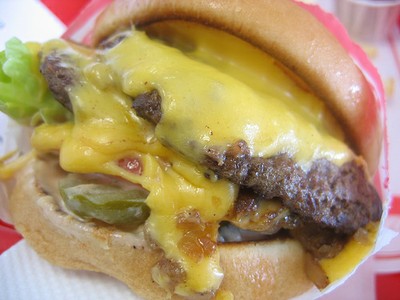
Burger photo courtesy of Flickr user Ack Ook under a Creative Commons license.






Laurel
The article is full of statisticonfusion (three times more likely? than what? were they also 3 times more likely to choose the “unhealthy” chicken nuggets?). Of course it doesn’t link to the study so we can’t tell if these problems are due to the study itself or just this particular case of reporting.Also, if people think that less calories == healthier, posting fast food nutrition information might encourage choosing french fries over a salad because the fries actually have fewer calories.
Michelle
Eric, I like your idea of making fries more expensive than salads, in order to encourage healthier food choices. It seems like that would really influence the dynamics, here.I guess I’m not surprised, though, that college students choose to include fries with their “healthier” meal, since most college students find fries difficult to turn down, anyway. (As do most of us when we eat out? :-)Overall, this study reminds me of that old joke about people who order a sugar-free “diet” drink to go along with their really fattening meal.
Eric Hess
Laurel –You’re right, the article isn’t perfect. But I think it does illustrate there’s a good chance that simply providing choices isn’t enough to make significant changes; we need to provide effective incentives to encourage smart choices. It’s more of a curious trend worth investigating than hard-hitting evidence.Michelle –I’m also a bit skeptical about the college student factor. But as a fairly recent college grad myself, I can say that I certainly made healthy choices when available. And the researchers did identify those individuals with “high self-control,” although it’s not entirely clear what that means. In short, I don’t think the college-factor is a deal breaker in this study.
Clark Williams-Derry
What I love about this is that the findings violate the principle of “independence of irrelevant alternatives.”An example of this principle: a patron walks into a restaurant, and asks what kind of pies they have. The server says, “cherry and apple.” The diner picks cherry. The server goes back to the kitchen, and comes back out to say they also have blueberry. And the diner says, “Well, in that case, I’ll have apple.”A lot of social choice theory and voting theory assumes that adding irrelevant alternative—the blueberry in this case—shouldn’t change your preference for cherry vs. apple. The blueberry just shouldn’t matter, since you’re not ordering it anyway! But there’s quite a bit of empirical evidence—this study included, but also the work of Daniel Kahneman and others—that offering irrelevant alternatives CAN change our preferences. Irrelevant alternatives aren’t irrelevant after all. In this case, the offer of salad leads to a preference of fries over baked potatoes. But one wonders if a choice of 4 salads and 1 chili dog with Cheez Wiz would lead people to choose the healthiest alternative—a nudge in the right direction.
Michelle
Hi Eric,Yeah, I agree that the college-factor isn’t a deal breaker. But, since college students were the ones used in this study to represent the general public, I find it typical that their high self-control broke down when presented with “party food.” (I happen to live in a university neighborhood, so I’m reminded DAILY about students and parties…)As Clark pointed out in his comment, “offering irrelevant alternatives CAN change our preferences. Irrelevant alternatives aren’t irrelevant after all.”In other words, high self-control suddenly becomes irrelevant when so-called “rationalization” (ordering a healthy salad) can talk someone into ordering fries (an unhealthy alternative) over a baked potato (a high self-control, healthy alternative).
Russ Finley
The unknown unknowns are always waiting to get you. Just finished a book called Stumbling on Happiness, which isn’t really about happiness. Our conscious choices are the tip of a large iceberg when it comes to making decisions. We are genetically wired to get by on autopilot most of the time.
Richard G
Of course, now it makes perfect sense that McDonalds offers salads. I wonder what happened to the sale of fries before and after salads were introduced?
Michelle
Richard G, good question! I’ll bet the fries sales went up. And, that people who wouldn’t normally eat at McDonalds went there at least once just to try the salads—and ended up ordering fries with their salads, too!
Tim
I don’t like the idea of taxing certain foods to encourage heathly eating. This seems like it would be an inherently regressive tax, as surely the foods being taxes would be more of the fast food variety (french fries, hamburgers) rather than unhealthy but expensive food options.
Michelle
Tim,Yeah, the tax’s regressivity crossed my mind, too. But, maybe hamburgers wouldn’t be taxed since they’re a protein source. (Although environmentally speaking, animal-factory farms aren’t good for the planet. So in that case too, “taxing the bads” might make perfect sense in the long run.) It’d be nice if the surplus money from the taxed “bad and unhealthy foods” could be used to supplement the price of the “good and healthy foods” in order to eliminate the tax’s regressivity. Especially since the idea in Eric’s post is to help eliminate the obesity epidemic.I know that if I ate meat and went into McDonalds for a meal, I’d end up ordering a hamburger with a side salad and totally skipping the fries, if the fries were “outrageously” more expensive than the more healthy options. *****(BTW, a little self-editing here: In my comment above, regarding the “irrelevancy” of high self-control, I’d like to substitute the word “meaningless,” if I may, since the poetic subtlety of the turn of phrase doesn’t seem to work very well when blogified. And Clark makes such a good point, I don’t want to distract from it!)