



It seems like every major Northwest city has one: a big costly road-expansion project. Seattle has the 520 floating bridge replacement (estimated at maybe $6 billion); Portland has the Columbia River Crossing (pegged at around $4 billion); and Vancouver has the Port Mann Bridge ($3.1 billion).
Each city is talking about steep price tags for dubious projects. These are projects that are likely to increase sprawl and driving—and that may even sap energy from the urban centers. And in each case, it’s hard not to wonder, what else could we do with that much money?
So I thought this piece of analysis was a bit ingenious:
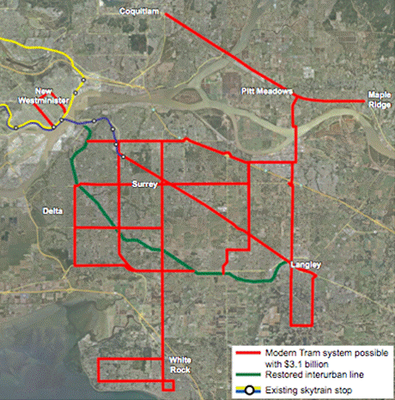
By the time Prof. Patrick Condon and researcher Kari Dow at the UBC Design Centre for Sustainability finished punching in the numbers and mapped their results, they produced a startling alternative vision. For the same money, concluded the team, the government could finance a 200-kilometre light rail network that would place a modern, European-style tram within a 10-minute walk for 80 per cent of all residents in Surrey, White Rock, Langley and the Scott Road district of Delta, while providing a rail connection from Surrey to the new Evergreen line and connecting Pitt Meadows and Maple Ridge into the regional rail system.
So there you have it. For $3.1 billion residents of Greater Vancouver should be able to choose either a) a single new 10 lane bridge, plus road-widening on each side, for a suburban commuter highway; or b) 200 kilometers of light rail stitching together a number of suburbs and towns in the Lower Mainland. Here’s the hypothetical tram map, centered southeast of Vancouver:
Wouldn’t it be great to see a map like this for Portland and Seattle?
I don’t mean to sound flippant. Whether or not Condon and Dow are exactly right about the cost of light rail and its reach, this is precisely the sort of exercise that should inform transportation planning. Instead of high-stakes zero-sum questions—do you want a billion dollars of new roads or nothing?—citizens should know what else they could do with the money. How many miles of streetcar line can be built for a billion? What would a billion do for express bus service? Or, what does a billion dollars worth of bicycle infrastructure look like?


Alan Durning
“What does a billion dollars worth of bicycle infrastructure look like?”!!!!!!!!!!!!!!!!!!!!!!!!!!!!!!!!!!!Also, why can Vancouver, BC, build 200 km of light rail for $3B? That sounds like about one tenth of the going rate in Washington or Oregon, though I haven’t crunched any numbers.BC’s infrastructure projects always seem much less expensive than US ones.
J
Meanwhile, the Washington senate decides to kiss federal matching money for crucial rail improvements goodbye, and spend what transportation money there is on massive road projects.
Henry
I’m from Vancouver. Patrick Condon’s analysis is likely not based on a full light rail system with stations and dedicated right of ways. That would escalate the price. I think he’s suggesting more of a streetcar/tram type system. Condon has done previous analyses on other multi-billion dolar projects in Vancouver.Also, your $1 US will buy $1.20 Canadian. Maybe that’s why the price is cheaper as well.
Jon Stahl
This is indeed exactly the right question, and it’s a shame that nobody in Washington has the vision and leadership to show us real alternative scenarios for our long-term transportation investments.