



State officials expect that climate change will create some profound water supply problems in eastern Washington. But there’s a potential solution that’s not only cheap, but also cute and furry: beavers.
Here’s the problem: according to climate scientists, warmer temperatures are already melting mountain snows earlier in the spring. That leaves streams and rivers short on water in mid-summer, just when salmon, farms, and homes really need it. Scientists expect that, as winter temperatures in the Northwest rise, the state’s summertime water shortages will only get worse. (The preamble in this state Executive Order has a nice, succinct rundown of the impacts of climate change that the state has already experienced.)
 To start dealing with the state’s slow-moving water crisis, Governor Gregoire asked the state ecology department to find ways to store more spring runoff. And, perhaps predictably, the department came back with some big, costly, and capital-intensive ideas: dams on Hawk Creek (pictured), Sand Hollow, and Crab Creek, three canyon tributaries to the Columbia River. Under the proposal, the state could pump spring snowmelt into reservoirs behind the dams, releasing it in mid-summer.
That might sound pretty reasonable, except for a few niggling details—like that fact that the dams would likely cost Washington taxpayers billions of dollars, while flooding thousands of acres of farmland and wildlife habitat.
The Lands Council, a Spokane based non-profit, thinks that it has a better idea: enhance beaver populations, and let the furry wonders do the dam construction for free!
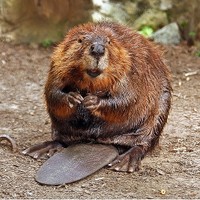
 Beavers once numbered in the millions in Washington State, before hunters nearly wiped them out for their pelts. Today, the state’s beaver population has grown to about 400,000—a welcome rebound, but still just a fraction of their original abundance. And since each beaver dam can hold three to four acre-feet of water, the Lands Council estimates that about a half-million new or relocated beavers could build enough small dams to store as much water as the big concrete behemoths—without all of the expensive construction.
Now, I have no idea if the Lands Council is right. But if the choice is between a trio of concrete dams that will cost billions, and a scoping grant for restoring beaver populations, I’ll side with the beavers any day. The Department of Ecology recently awarded the Lands Council a grant to assist with research, working with landowners, and investigating the economic potential for water banking and conservation easements. And the council is hosting a Working Beavers forum at the end of the month to explore the idea further—see here for more information.
Of course, the chance to restore beaver populations doesn’t take away the sting of climate change. Still, there’s a bit of comfort in realizing that, every once in a while, there’s a solution to a complex human problem that’s also a boon for nature.
The first draft of this post was prepared by John Abbotts, a long-time friend of Sightline. Beaver picture courtesy of Flickr user sherseydc (steve).


Naturally Interesting
How exactly does one go about capturing and importing 500,000 beavers? I’m envisioning something along the lines of Operation Dumbo Drop, but on a much larger scale.
heidi
I realize naturally interesting is in jest, but dropping beavers by parachute was actually tried in oregon. I don’t recommend it. Read Eric Collier’s book “Three against the wilderness” to learn about introduced species effect on the habitat. Thanks for the great article. Heidi PerrymanPresident & FounderWorth a Damwww.martinezbeavers.org
Brian
As the Watershed Program Director for The Lands Council and manager of this grant, I can assure you that we have no intent of parachuting beavers into the wilds of Washington. In our work, we have already been working with several agencies in Washington that currently live trap beavers. Their problem is that it can be difficult to locate suitable locations to release these beavers where human conflict won’t crop up again in the near future. Through our efforts, we plan to work with state agencies and private landowners to locate several hundred thousand locations that these trapped beaver can be readily moved to where they will be well away from roads and culverts that probably got them trapped in the first place. Along with the water storage potential, we are also keeping an eye on the potential for wetland restoration, sediment retention and other benefits that beaver ponds can provide.
Clark Williams-Derry
PleasePleasePLEASE start parachuting a half million beavers into eastern Washington as soon as possible!!! And I want to see it on Youtube!!!
shira
Go for it Brian! Beavers are the capstone species that make upland wetlands wet land and not just an eroded water slide. The other thing that we need is more trees allowed to wash downstream and do what they do, get hung up and provide nursery habitat. Eventually the trees end up in the Sound, where they provide more invaluable habitat and hazards to navigation, hence the anti-tree attitude.
Dave
I can vouch for Brian with regard to the difficulty of finding suitable locations for re-locating beavers. At a wildlife refuge near my home, beavers were continually damming a water control structure, causing flooding into neighboring private land, and other problems. The refuge manager tried very hard to find some agency who could remove the beavers, but they all said that there was no suitable place, “any place that would be good for beavers already has beavers”, and that killing them was the only option.
Joye Redfield
I’d like to point out that the state of Washington has provided a $30,000 grant to the Lands Council to study the feasibility of this project. Large story is NOT the primary investment being made by the Department of Ecology. In 2008, $46 million was designated for projects designed to develop additonal water supplies in Eastern Washington, ranging from conservation projects, infrastructure upgrades, aquifer storage, ditch linings, pipings, pump exchanges etc. The goal is to make more water available to enhance stream flows for fish and to support new out-of-stream uses.
Jay Coleman
The need to balance a person’s ownership of land with the larger context of the community’s need for water via a simple solution? Beavers do need a habitat and are cheap builders. As an interested fisher person in the western mountains, I noticed the nice level fields/meadows left behind after the beaver’s pond had filled in with sediment. Of course, they had moved on to other areas to build new dams. In other words, beavers build temporary structures if you look over a longer time span. Maybe we should be looking at this, as a community, to view an individual’s current land “right” with the community’s need for water and compensate the landowner by renting the land for the beaver’s use(and henceforth the community’s use) while suspending the taxing of that land, unless the landowner wished to use the land in the condition the beaver “modified” it? The land would then be taxed at a lesser rate if the owner chose to still occupy it.However, it should be noted, not all beavers are supreme builders and we, as a community should remember this and always keep an eye on what’s downstream. Be that as it may, it is still a better option to have built many smaller holding ponds than larger dams.
Bob Vadas, Jr.
One doesn’t need to put in tons of beavers to get them to recolonize historic habitats; they reproduce just fine on their own, thank you. Their ability to modulate flows and restock streams with large-woody debris can definitely benefit fishes, as long as instream flows aren’t depleted further to cause water-quality and/or fish-blockage impacts. Here’s some more relevant web sites:http://www.beaverdam.infowww.nwcouncil.org/news/2008/03/3.pdfhttp://www.hww.ca/hww2.asp?pid=1=82=8http://www.landscouncil.org/water/what_can_beavers_do.asp
Matt the Engineer
Is this a good sign (beaver populations increasing enough to notice them) or a bad sign (yet another suburban development forces beaver to relocate to the urban environment)?http://www.myballard.com/2009/06/03/what-is-this-strange-animal/
Kevin Taylor
@ Clark Williams-Derry: I think Balloon Boy was the pilot project for this, no?
Tom Putnam
As a boy in Missouri I learned of the essential role that beavers played in the incredibly fertile ecosystem of the original prairies, providing wetlands and habitat for fish and waterfowl. Along with the loss of topsoil, the destruction of beaver dams was one of the most devastating effects of opening up millions of acres to agriculture.This still remains a problem—re-introducing beavers would conflict with a lot of land-uses, but being receptive to the idea as a solution (not preemptively destroying every beaver in sight and actively encouraging them where feasible) could go a long way in letting nature help us solve problems that we have produced by destroying natural systems in the first place.
John Abbotts
Hello Beaver enthusiasts,
It is over four years since the original post (OMG, was I ever that young!), but I recently learned of another beaver restoration project in the Methow Valley WA. The project began in 2008, which may be before the Lands Council received their grant.
The Methow Valley project has a goal of restoring 50 new beaver colonies in the Valley over 10 years. The project is funded in part by Ecotrust, based in Portland OR. The link to the Ecotrust blog post, which includes a link to the Project itself and a description of the Project partners, is at http://blog.ecotrust.org/beavers-natures-first-river-restoration-engineers-2/
In the meantime, the Lands Council project has continued to move forward. As of late 2012, they had moved 7 families, collectively 45 beavers, to the Colville National Forest, in collaboration with the Forest managers, or to private property of willing owners throughout NE Washington. They also collaborated with an eastern Washington legislator to enact a WA State bill that among other features would allow the WA Department of Fish and Wildlife to issue permits to organizations (such as the Lands Council) to relocate, rather than kill, beavers considered a nuisance by landowners. That bill passed and was signed into law by Governor Gregoire in March 2012. And in a Dave Barry “I am not making this up” twist, the Lands Council’s chief lobbyist for the bill was Neil Beaver. More information on the Council’s work, along with links to news items and their Beaver Chronicles page, can be found at http://www.landscouncil.org/beaversolution/