



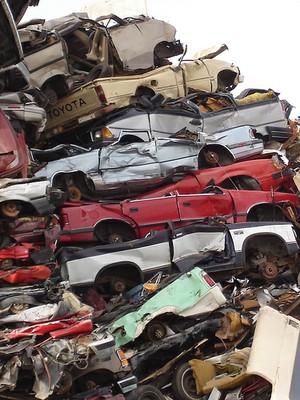
 I came across this article in the Oregonian this morning (and haven’t been able to stop making puns about it since).
A company that used to build commercial car carriers is now building homes out of junked cars (those pancaked stacks you see on trucks). It takes four to six of these cars to provide enough steel for the frame of the house.
What seems especially cool is that not only are they recycling cars to make these houses, they’re also making them energy efficient and affordable:
“Over the course of a year, the team made energy efficiency their mantra. They emphasized a tight structural envelope encased in rigid foam insulation and slathered wall cavities and crawl spaces with blown-in foam insulation for a more airtight seal. The finished, insulated crawl spaces between floors containing the home’s heating, ventilating and cooling systems allow for shorter duct runs and smaller, high-efficiency furnaces”
…”What’s more, Boydstun’s experimental model home—based on a stock plan from a magazine—was completed for $95 a square foot.”
Not to mention it only takes 45 days to build one, instead of six to nine months, and with five workers instead of fifteen.
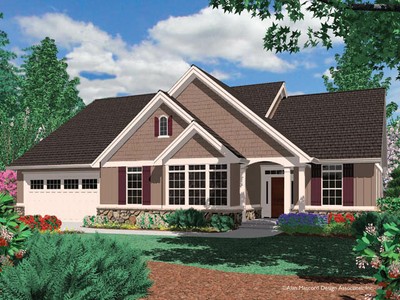
 It’s not all rosy, though. They houses they’re building are described as “suburban”–and as Clark pointed out last week, suburbs might not be the most carbon-friendly option. Still, while the article highlights a 2,600 sq. foot home, most of the homes on their website measure in under 2,000 sq. foot (the average home size in the US in 2004 was 2,300 sq. foot). And, there doesn’t seem to be any barrier to building smaller homes for compact communities using the same principles—indeed, they’re working on a 1,200 sq. foot cottage model.
And now for the real question: does the house have four doors or two?
Junked car photo courtesy of Flickr user Summersumz under a Creative Commons license.
Home photo courtesy of mirandahomes.com.






joshuadf
This is actually quite similar in techniques to projects like 99k House and 100k House (1000 sq ft house with modern design for urban infill). Note that those costs are only the house, not the lot.
Turbodave
Steel framing is a good idea; but the suburbs and the size of the house rather negate the appeal. The 1,200 SF “cottage” built in town is a worthy goal.
charlie
I’m getting a vibration here, something about the amount of energy needed and carbon spewed to transform cars into houseparts. As a buzz-killer, I’m tempted to compare/contrast this approach with the energy and carbon footprint of trees growing lumber for the exact same houseparts. Hmmm. Wonder which is more sustainable?
Mark
Well, we can still grow trees for their carbon reducing benefits. And what do we do with all of those crushed cars if we don’t recycle them? In this terrible car market we’re still building almost 10 million of them a year. In better years it’s more like 16 million. We have to recycle them for something.
Michelle
Another thing that would be interesting to look into is weighing the fact that the house will support a lower carbon footprint for a hundred years or more against any difference in the initial carbon footprint of the raw materials.
SA
One of the most important benefits of steel construction is quiet simple; wood molds steel does not.
Drew
its really nice to know that instead of putting cars and into garbage they thought of things that could possibly be worth of trying for like creating new house with the use of this car and parts, with this idea for sure many people will be beneficiary.