



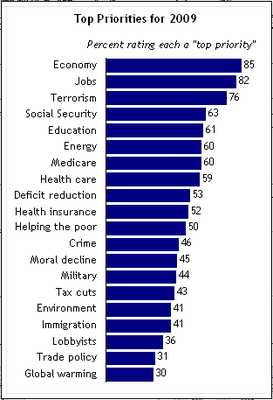
At first glance, the latest poll numbers from Pew Research Center on Americans’ top priorities for the new president might appear worrisome to climate policy advocates.
Global warming is in last place in the top 20 and the environment in general slipped down in the list since last year. Andrew Revkin over at NYT’s Dot Earth blog goes so far as to say “America and President Obama are completely out of sync on human-caused global warming.” (There are some startling new numbers from Rasmusen on that question…)
But I’m convinced that’s not the point. The fact is, solutions that will address the top two concerns—the economy and jobs—as well as several other top 10 concerns—energy, terrorism, helping the poor—are all wrapped up in the best solutions for combating climate change.
The fossil fuel roller coaster has long whiplashed family budgets, and our economy remains shackled to its adrenaline-boosting unpredictability. Any economic recovery we muster in coming months will sputter if we fail to reduce our fossil fuel dependence. As soon as the economy rebounds, oil prices are sure to shoot up again, negating the economic gains that we’ve made.
Our job now—and Obama’s—is to encourage fellow lawmakers and citizens to connect the dots and stop seeing the economy, energy policy, and the environment as even vaguely separate issues anymore.






Barry
Exactly.One of the great things Obama has done is to continually highlight the linkages between our energy problems, our economy problems and our climate chaos problems.One solution helps defuse them all: getting off fossil fuels.In terms of impacts, the economy is hurting most Americans today, the next fossil fuel crunch will hurt most Americans in a year or two, and climate change, while far worse in the long run, will not clearly hurt most Americans for a few years more.While I don’t agree with the priority order listed, I can see why people are asking for help with the short-term, in-my-face-now problem. Especially now that Obama has explained that fixing one will fix the others.
Levin
In order for lawmakers and citizens to connect the dots, we need a national set of sustainability indicators. This will help us to recognize and adopt simple solutions that solve many problems at once. If proposal (A) would improve one topic while making 3 other things worse, and proposal (B) would improve 4 different topics all at once, for the same price as (A), without making anything worse, then (B) should win. Sightline could help “stop seeing the economy, energy policy, and the environment as even vaguely separate issues anymore” by revising the annual Sightline survey. It always asks which single issues I care about. I care about solutions that address 3 or more different challenges at once, cost-effectively, but that’s not one of the multiple-choice options. This demonstrates how pervasive the analytic mindset is. We need solid tools, such as one set of sustainability indicators applied to all federal projects, to support and encourage more wholistic ways of thinking.
Anna Fahey
Great point, Levin! Even Sightline’s annual audience survey reinforces these false divisions. Of course, we give our readers a chance to check more than one answer. Still, it does show how pervasive the problem is. I would be thrilled if pollsters would start asking their questions to reflect these connections. The problem for them is that they rely on long-standing benchmarks and thus hesitate to alter the question formats too much. So, it’s up to us to read between the lines—and help make the connections more concrete in more people’s minds.
Todd
Levin – right on to your insight that we should be looking for solutions that address multiple issues (and the relationships among them) simultaneously. Another danger is thinking in terms of priorities. Rather than “priority”, may I suggest “sequence.” What is the most efficient and efficacious (sp) sequence by which the entire set of issues in question can be resolved?