



For graphic proof, here’s a nifty chart derived from this very large powerpoint presentation by Cambridge Systematics. The yellow arrow represents the passage of time, the horizontal axis represents fuel economy (increasing for the first 12 years) and the vertical axis represents horsepower (on the rise since the late 1980s).
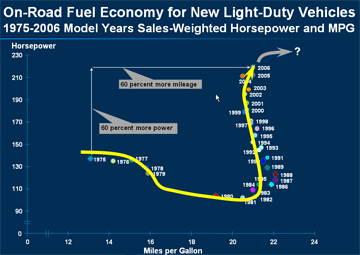
The numbers show that, as of 1975, the average new passenger vehicle burned 7.6 gallons of gas for every 100 miles driven. By 1987, that had fallen to 4.5 gallons—meaning that new cars used about 40 percent less gas than they did 12 years earlier.
By any measure, a 40 percent decline in gas consumption in just 12 years is quite an accomplishment! The fuel savings were the result of two simultaneous trends: the average car got lighter, and engineers tuned new car engines for efficiency rather than power and acceleration. In short, the auto industry—from boardroom to design shop to factory floor—focused its efforts on squeezing more miles out of less gasoline.
But in the mid-1980s, oil prices fell, the economy picked up, and federal fuel-economy standards topped out. So car manufacturers switched gears, pouring their technological advances into increased vehicle weight and horsepower. As a result, automotive engineers spent most of their time trying to squeeze as much torque and acceleration out of their engines as possible. Efficiency gains stalled at first; and then later, with the rise of SUVs and other light trucks, fleet-wide fuel economy actually went into reverse.
Fortunately, since 2004—when fuel prices started to rise in earnest—we’ve notched some modest improvements in fuel economy. Yet preliminary data for the 2007 model year suggest that those improvements may have hit yet another road block, with an incremental gain in horsepower but no improvements in fuel efficiency. Sigh.
I know, I know, I’m running the risk of sounding like a chiding schoolmarm, tut-tutting over Americans’ collective shortsightedness in choosing muscle over efficiency.
But I’m trying to make a different point altogether: given the right conditions, technological change can be incredibly rapid. We forget this all the time, and fall into the trap of believing that the way things are right now is how they’ll always be. But a simple change in policy (or a steeper change in prices or economic conditions) can foster rapid changes in our appetites and behaviors.
That’s exactly what happened in the late 1970s and early 1980s: we hit a crisis, Congress passed some new standards, and quite quickly the automotive industry reinvented itself, ratcheting up fuel economy at a pace many people thought would be impossible. Even the last few decades of fuel economy stagnation have hidden remarkable change: automotive engineers have squeezed ever more horsepower out from under the hood, with little overall change in fuel efficiency.
So to anyone who says that fuel consumption is a given—that big automakers are simply unable to respond to new incentives or meet tougher fuel economy standards, or that consumers simply can’t alter their vehicle preferences—I say: take a look at our history. Change isn’t just an abstract or theoretical possibility. It’s what we’ve been living with, well, for as long as any of us can remember.
Photo by Telstar Logistics, distributed under a Creative Commons license.






sf
On other boards, I see younger commenters claiming that a 55 mph speed limit would be futile because it would be ignored. Looking at this graph, I can see why there is an age divide here between people who were driving in the 70’s and people who got their first license after 1985
Clark Williams-Derry
sf- That’s a good point! Of course, younger drivers also probably don’t remember the aggressive speed traps that state troopers used to set up, to keep speeds below 55. As I recall, states could lose federal highway money if they didn’t keep speeds around 55, so some were pretty aggressive about enforcement. It’s easy to ignore a sign, but not so easy to ignore flashing blue lights.
SirKulat
Bringing up the speed limit on freeways may be the best way to argue for fuel economy and against horsepower. Reducing the speed limit to 55mph back in the 70’s improved fuel economy mostly because of the poor aerodynamics back then. With today’s cars, reducing the freeway speed to 55mph would not improve fuel economy near as much. The more important achievement with the 55mph speed limit was reduced accidents and fatalities. Most cars then and now are equally overpowered. Vehicular safety standards can only improve if horsepower decreases. This goes for freeway, inner-city thoroughfare and neighborhood driving. Overpowered automobiles have a built-in guarantee of being accident-prone. Many safety standards are possibly only with electric motor drive. Plug-in hybrid technology in particular offers the safety feature of improved stability and handling via careful placement of battery weight low on the frame to lower vehicle center-of-gravity, which is perfect for roll-prone, top-heavy SUVs. All that said, we drive too much, too far, for too many purposes. And we build cities and suburbs with abominable disregard for the safety of pedestrians and bicyclists. The automobile is still the devil.
SirKulat
Looks like Sightline’s readers/commenters/op-editors are uninterested in public safety and more attuned to the holy grail techno-fix guru status cheap symbolism. Meanwhile, the party of business, the GOP, has decided to punish a blue state by awarding a lucrative military aircraft contract to a red state. Perhaps Washintonians are beginning to develop a conscience? Gotta crush that patriotic sentiment right now!
CitizenJ
Interesting graphing concept. It would be much better if the previous cycle (~1965-72) were also shown.We’re now seeing the end of the second “Horsepower Wars” period in my lifetime. There are some amazing machines available now, just as the equipment from the end of the previous period retains its value as collectors because of the work put to their engineering, styling, and purpose.The ’08 Chevrolet Corvette as a fuel efficient sportscar. Who wouldv’e thought… Our cars are rapidly becoming smaller (SUV-> Crossover, E-Sedan-> B-Sedan, V8-> L4, 3,900lb-> 2,900lbs).I’ve never heard anywhere before that PHEVs yield improved stability and handling! That statement should be carefully conditioned.
Mike Swift
As a mechanical engineer I can’t see the fascination in the public, and reporters, in horsepower. Auto design is governed by three factors. weight, frontal area, and drag coefficient. Engine power needs to be high enough to give “lively” acceleration. If this is met there will be more than enough power to travel 80 to 100 mph. The increase in power in most cars is related to their weight. In marketing size and weight are equated with safety and usefulness, and of course high power is needed to give an expectable acceleration. Of course some cars are sold on their horsepower like the new Corvettes at 600 horsepower, but they are a very small part of the market.
Bryan Sellars
I’ve been checking out a few websites on mpg versus speed and not one of the graphs shows anything but a downward trend above 50mph, at 55mph you are starting to pay for it at the pumps, and if we want to have reasonably price fuel the less we use the better, some of the younger drivers may want to consider that they could run out of easily accessible fuel in there lifetime, use it and lose it.
John M. Dique
Bits and pieces:
I read somewhere that as a response to one of the Oil crisis, the high way speed limit in the U.S. was lowered to 55 mph, with a resulting fuel saving across the nation of 15 % : Billions of dollars in fuel, possibly a similar figure was saved in things like reduced wear and tear on wheel bearings, engines etc, and definitely in accident insurance claims, and of course life and limb. I suspect there was less stress, which has health cost benefits.
In 1964, A new Australian car emerged, the EH Holden, 179 cu in straight six OHV engine. A road test at a steady 30 mph achieved 38 mpg [ Australian Gallons.] This car weighed about 2300 lbs.[ similar dimensions to the 170 cu in Base Mustang of the same year ….]
The average speed across town is limited by traffic lights to about 22 mph.
[ just under the top speed of an electric or petrol golf cart . ….There’s a whole other discussion !]
Now compare with the 2000 model VT Holden [ a popular 2nd hand model. ] with its 225 cu in Buick derived V6, with electronic fuel injection, 4 speed auto and vastly improved aerodynamics. The VT gets about 20 mpg across town. Mmm and the 2013 VF Holden uses only slightly less.
O.K. sure on the highway, its reversed, the ’64 Holden gets maybe 22 mpg , but , with the tall diff, the VT gets about 32 mpg, and the 2013 VF about 34 mpg.
BUT consider : with an ageing population, diminishing eyesight, and reaction time, highway driving fuel efficiency may not be the priority, so …….
Here’s my question : Should we be thinking about designing medium sized sedans with low speed fuel efficiency as a priority ? Certainly there could be some other benefits. So consider now the Corvette, 2008 mpg vs speed graph : 36 mpg at I think, from memory, something like 20 mph.
Somewhere I read that at a steady highway speed, modern aerodynamic cars use only on average 9 % of their available horsepower.
john M. Dique
other related info ; The ’64 Holden had roughly 110 BHP. It weighs aprox 2300 lbs
The 2000 VT Holden has about 198 BHP. It weighs aprox 3400 lbs.
The 2013 VF Holden has about 225 BHP. weight around 3400 lbs .